

Insights / Perspective
Bilyk Financial Insights
Midterms, interest rates and the energy behind AI
Our perspective on policy uncertainty and the infrastructure needed for long term growth
By Bilyk Financial · November 5, 2026
AI-generated conceptual image of a data centre and electricity infrastructure. It does not depict an actual facility.
The market volatility following the U.S. midterm election results, weakness in chip and data-centre shares and uncertainty around the AI buildout have brought several competing developments into focus. [8] When prices and headlines move this quickly, it can be difficult to keep your longer-term future in perspective. At Bilyk Financial, we want to explain how we are interpreting these developments and what they mean for the conditions families and businesses need to plan with confidence.
We are watching whether policy can respond to economic pressures without creating unnecessary disruption, and whether the energy system can keep pace with demand. Those issues matter because they affect household costs, business investment and the longer-term plans our clients are working toward.
Elections and predictable policy
Historical election data can help us try to put immediate uncertainty in perspective. In BlackRock's study of midterms from 1970 to 2022, the S&P 500 gained an average of 14.1% over the following 126 trading days, or roughly six months. When the party holding the White House and both chambers of Congress lost control of at least one chamber, the average gain was 10.4%. In the other midterm scenarios studied, it was 16.1%. Both groups recorded positive average returns over that period. [1]
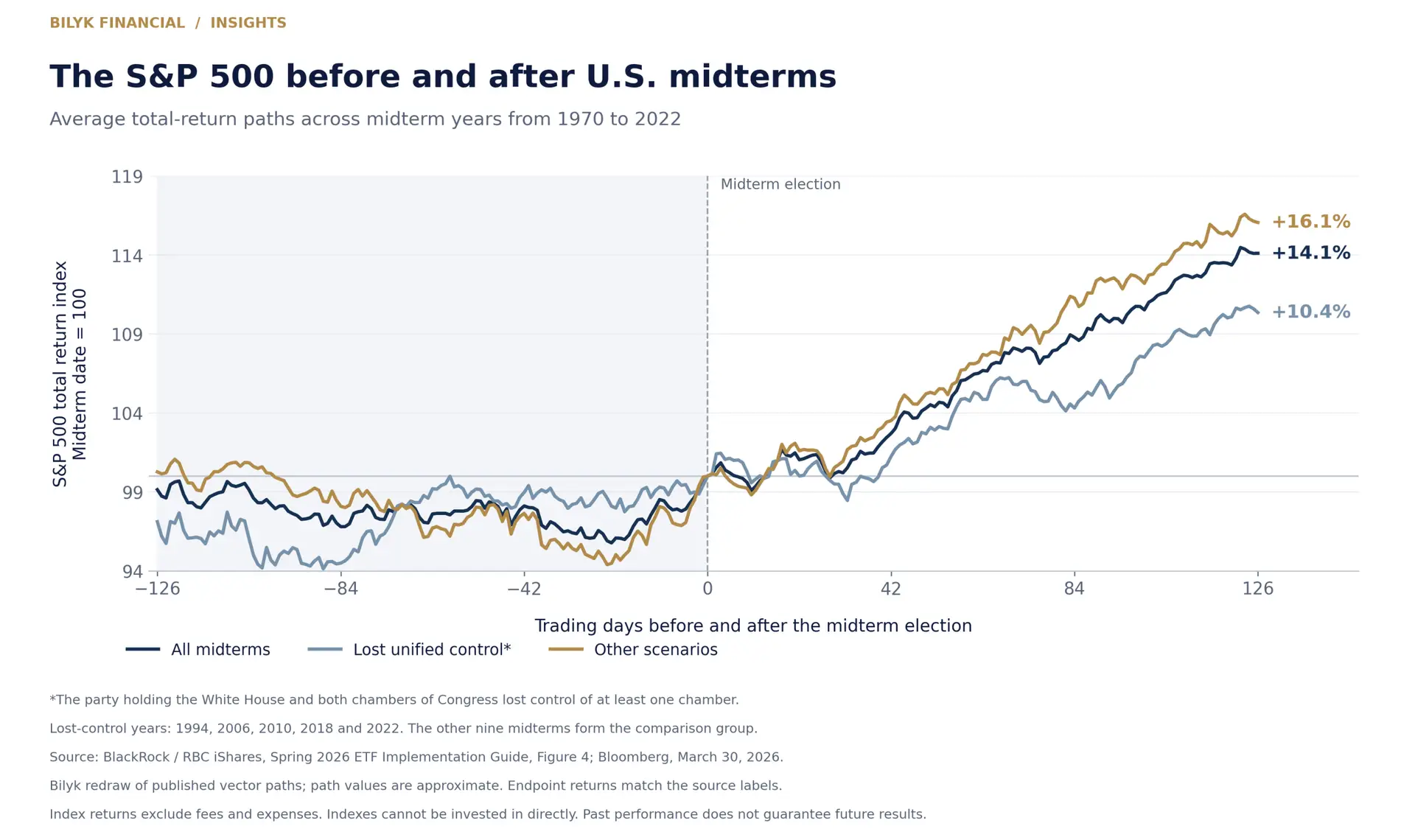
Source: BlackRock / RBC iShares, Spring 2026 ETF Implementation Guide, Figure 4, using Bloomberg data. Bilyk Financial redraw of the published chart; paths are approximate and endpoint labels match the source. Index returns exclude fees and expenses; past performance does not guarantee future results. [1]
Divided government carries a real risk of gridlock, where important decisions stall. Even so, we believe policy that can respond to changing economic conditions remains essential, and meaningful changes can still be achieved through negotiation. A House of Representatives controlled by a different party from the White House can provide a useful check on the scale of sweeping legislative changes. We are concerned that abrupt policy shifts and geopolitical conflict undermine confidence and put pressure on household and business finances. In our view, stronger congressional checks could help rebuild confidence to commit capital while leaving room for necessary economic policy.
What concerns us about interest rates
On October 28, the Bank of Canada increased its policy rate to 2.5%, while the U.S. Federal Reserve held its target range at 3.75% to 4%. The Fed had raised that range in September. In its October statement, it described economic activity as strong, inflation as elevated and unemployment as little changed. [2][3][4]
Policy rate decisions
September 16, 2026
U.S. Federal Reserve
Raised 25 basis points
3.75%–4.00%
Target range for the federal funds rate
October 28, 2026
Bank of Canada
Raised 25 basis points
2.50%
Target for the overnight rate
October 28, 2026
U.S. Federal Reserve
Held unchanged
3.75%–4.00%
Target range for the federal funds rate
To us, the Fed's September hike followed by October's hold sends a contradictory signal. Its October statement continued to describe elevated inflation and strong economic activity, while saying more information would help determine the appropriate policy stance. [3][4] If the evidence in September was insufficient to justify a hike, we believe that hike should not have occurred. Investors deserve a clear explanation of what changed between the two decisions and why the earlier action was warranted. Without that clarity, confidence that policymakers are in touch with the economy can weaken.
We believe central-bank decisions should reflect economic conditions and remain independent of political pressure. Consistent reasoning matters because uncertainty about the policy response filters into borrowing, spending and investment decisions.
Energy is part of that challenge. The Bank of Canada warned that high fuel costs are raising production and transportation expenses, with more cost pass-through expected. For a family or business owner, that can mean pressure on both everyday spending and longer-term plans. [2]
Digital growth is expanding the infrastructure challenge
The expansion of the digital economy strengthens our conviction that demand for infrastructure and energy will continue to grow. Global fixed and mobile internet traffic more than tripled between 2019 and 2024, according to the IEA, alongside rising broadband connectivity and 5G coverage. That growth helps explain the physical infrastructure required to support the services people and businesses use every day. [6]
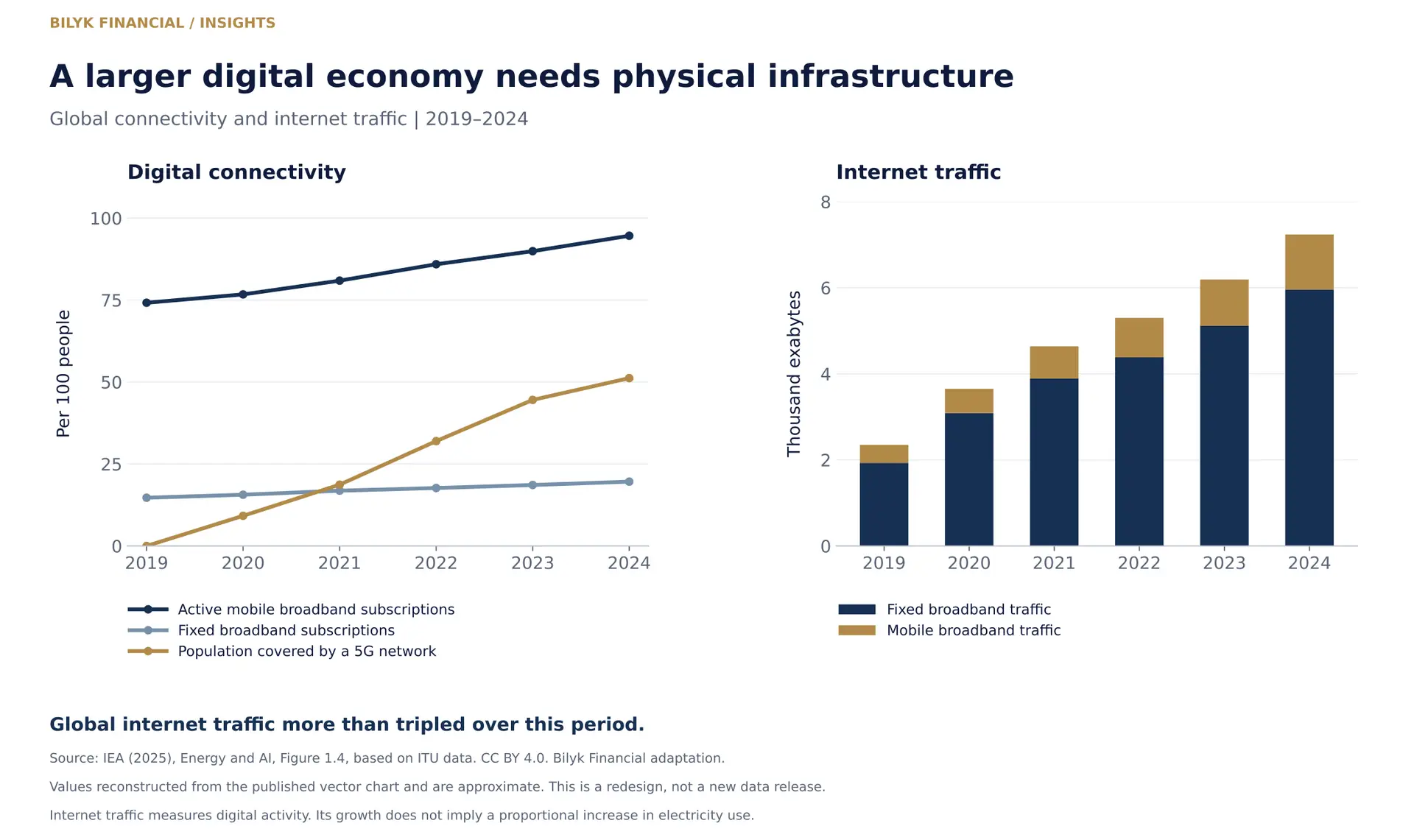
Adapted by Bilyk Financial from IEA (2025), Energy and AI, Figure 1.4, based on ITU data. CC BY 4.0. Values reconstructed from the published vector chart are approximate. Internet traffic measures digital activity, not electricity consumption. [6]
To us, current market concerns about AI spending do not remove the need for reliable electricity. We expect sustained demand for power and grids to put increasing pressure on policymakers to enable essential infrastructure. Clearer approvals, grid expansion and additional generation could be positive catalysts for that buildout. Individual projects can still be delayed or cancelled, and greater computing efficiency can reduce the energy needed for each task. Our conviction concerns the broader need for dependable supply.
We believe the energy required to support AI deserves more attention. The International Energy Agency projected in its 2025 base case that global data-centre electricity consumption would more than double to about 945 terawatt-hours by 2030. That forecast is uncertain, but it illustrates the scale of the infrastructure question. [5]
Putting data centre electricity demand in household terms
A 2,000 MW data centre, like an under-construction example in the IEA's 2025 report, could use as much electricity in a year as roughly 1.69 million average U.S. homes if it operated at full capacity throughout the year. A 5,000 MW project would be closer to 4.22 million homes on the same basis. [6][7]
These comparisons make the potential demand easier to picture. Actual consumption depends on how much of a facility is built and used; the chart below shows the assumptions behind the comparison.
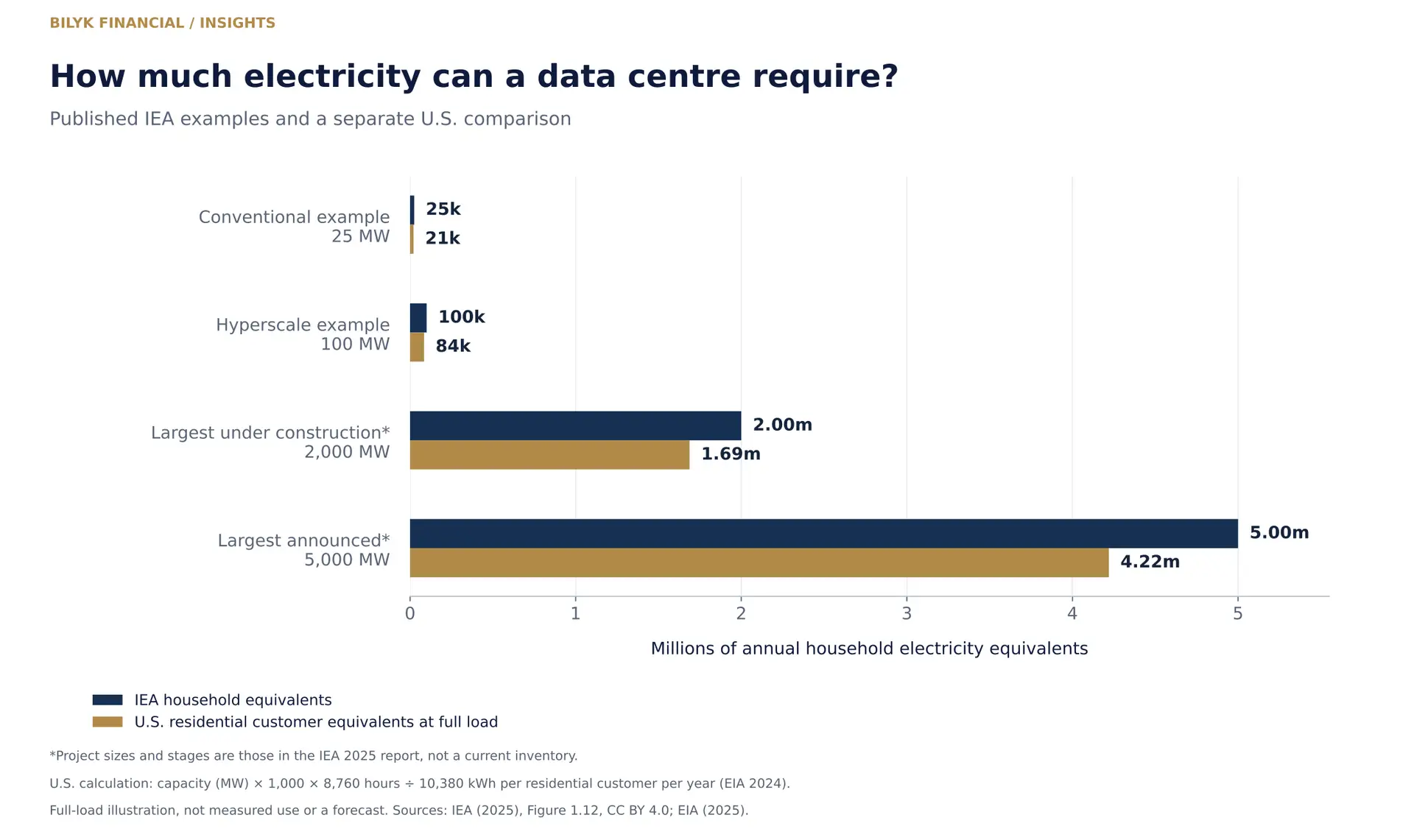
That scale reinforces our view that electricity supply deserves a central place in discussions about AI growth. Large projects need generation and grid connections that can be delivered on time, alongside the energy needs of homes and other businesses.
A broad energy mix and realistic timelines
The timing matters as much as the amount of capital committed. A power plant or transmission network cannot be built overnight. The IEA notes that new transmission lines in advanced economies can take four to eight years to build. [5]
Our conviction is that meeting demand reliably will require a broad mix of solutions. Renewables and storage have important roles, alongside natural gas, nuclear power, grid investment and efficiency. We do not believe renewables alone are a practical near-term answer in every market. The IEA also anticipates a varied supply mix, with renewables meeting roughly half of the additional global data-centre electricity demand through 2030. [6]
For us, the goal should be dependable, affordable supply as the economy grows. The race to expand AI should account for the effects on households and other businesses that depend on the same electricity system.
Electricity capacity and oil prices are related but distinct issues. Building more power generation will not automatically lower the global price of oil or quickly eliminate inflation. We see energy diversification as a longer-term resilience strategy, while geopolitical developments remain an important near-term uncertainty.
Keeping the purpose of your money in view
Our preference is to stay committed to a suitable long-term plan while reassessing the assumptions behind it. That includes distinguishing money needed soon from capital intended to support goals many years away. A change in your circumstances can warrant a different approach even when the market outlook is unchanged.
Energy and infrastructure remain areas we believe deserve close research. Growing demand alone does not ensure attractive investment returns: the price paid, borrowing costs, regulation and the ability to complete projects still matter.
We want our perspective to help families understand the questions behind the headlines. How persistent are cost pressures? How predictable is the policy environment? Can the infrastructure being promised actually be delivered? Those questions help connect today's developments with the financial decisions that matter over time.
Sources
- BlackRock and RBC iShares. ETF Implementation Guide Spring 2026, page 7. S&P 500 total-return study of midterm years since 1970; 126 trading days after each election.
- Bank of Canada. Policy rate announcement, October 28, 2026.
- Federal Reserve. FOMC statement, October 28, 2026.
- Federal Reserve. FOMC statement, September 16, 2026.
- International Energy Agency. Energy and AI, 2025, executive summary. Projections are scenarios, not observed future outcomes.
- International Energy Agency. Energy and AI, 2025, Figures 1.4 (page 24), 1.12 (page 38) and 2.20 (page 86; discussion on page 87). Digital connectivity, household electricity equivalents and the electricity supply mix. CC BY 4.0.
- U.S. Energy Information Administration. Residential electric bills in Hawaii and Connecticut are twice those in New Mexico, Utah, May 12, 2025. 2024 U.S. average monthly electricity purchases: 865 kWh per residential customer.
- Reuters. S&P 500 futures steady after midterm rally; Nasdaq lags on chip weakness, November 5, 2026. Market context for post-election volatility and concerns about the AI buildout.