

Insights/Perspective
Bilyk Financial Insights
Where Canada can help when the AI trade cools
Canadian equities can reduce dependence on technology valuations. Their usefulness depends on what happens to the spending behind AI.
By Bilyk Financial ·
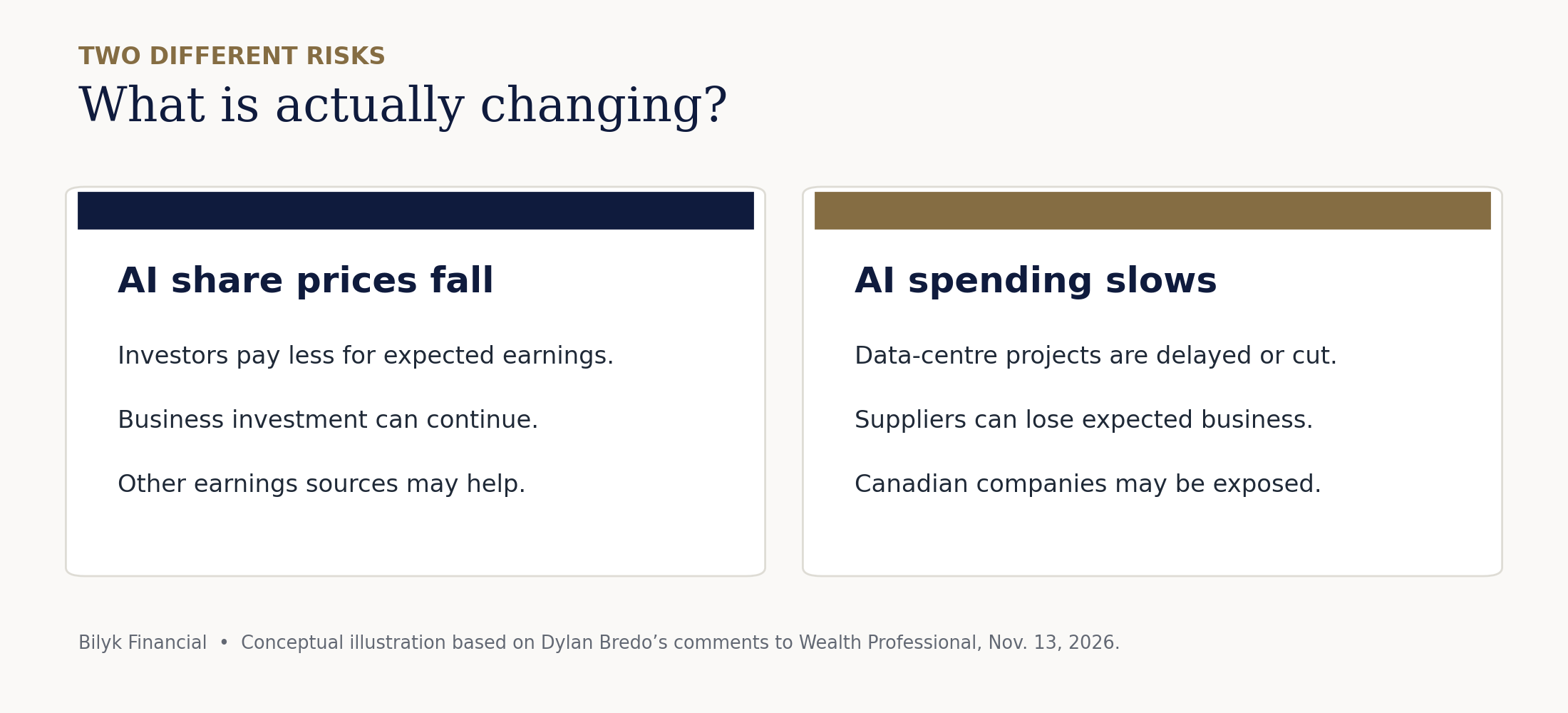
Canada can play a useful role in a portfolio that has become heavily dependent on the AI trade. We believe that case is strongest when investors are reconsidering what they will pay for technology stocks while the businesses behind them continue to invest and grow.
A slowdown in the construction of data centres would be a different matter. Canadian businesses that supply equipment, power or related infrastructure could feel the effects too.
Dylan Bredo, CFA, MBA, a partner at Bilyk Financial Private Client of Aligned Capital Partners, explained the distinction in a recent Wealth Professional interview:
“Canada might be a hedge against AI stocks getting cheaper. It is not a hedge against AI spending slowing down.”
Dylan Bredo, CFA, MBA · Wealth Professional, November 13, 2026
That distinction guides our view. Canada offers ways to spread investment risk across different businesses, but its usefulness depends on the risk a portfolio is trying to reduce. [1]
In our previous article, Midterms, interest rates and the energy behind AI, we discussed the need for dependable electricity and infrastructure. This is the portfolio question that follows: how much of an investment’s value depends on that buildout continuing as expected? [2]
A lower share price does not always mean a weaker business
A company’s share price reflects both its earnings and what investors are willing to pay for them. Those two things can move independently.
Consider a simplified example. A business earning $10 per share would trade at $300 if investors paid 30 times its earnings. At 25 times the same earnings, its share price would be $250. The stock would have fallen almost 17%, even though earnings had not changed. This is an illustration, not a forecast for any company.
That helps explain why a technology sell-off can create an opportunity for other parts of the market. If spending and economic activity remain healthy, businesses with different customers and less demanding expectations may hold up better. The possibility of that rotation is the part of Dylan’s argument we find persuasive.
View chart at full size
Canada offers a different mix of businesses
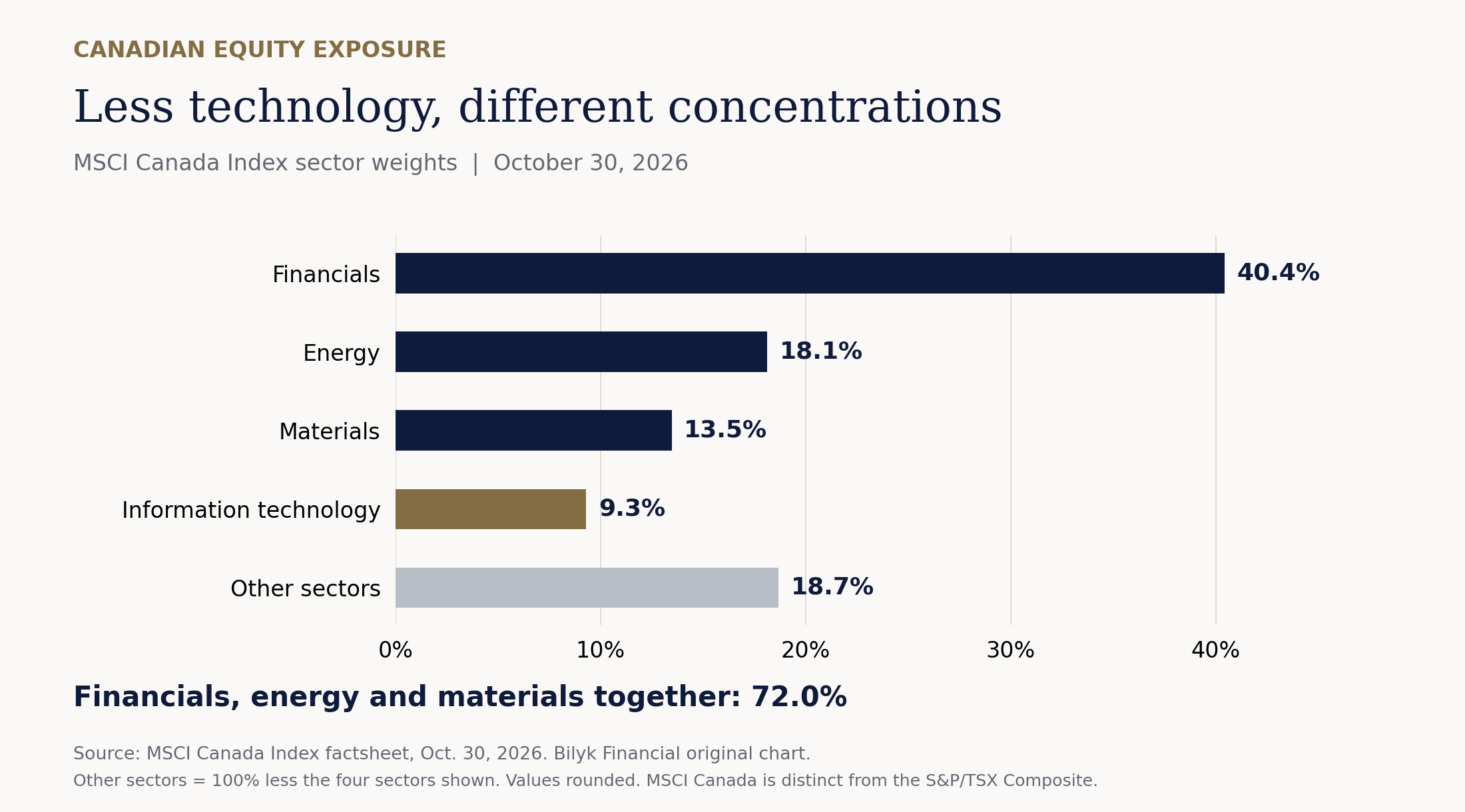
Canadian equities give investors meaningful exposure to financial services, energy and materials. In MSCI’s Canada index, those three sectors represented about 72% of the market on October 30, 2026. Information technology accounted for 9.3%. [3]
View chart at full size
That mix can reduce reliance on technology earnings and valuations. It also brings its own risks. Banks depend on borrowers’ financial health, and resource businesses remain sensitive to commodity prices. A portfolio can become less exposed to technology while still being concentrated.
Valuation offers another reason to look closely. On the same date, MSCI Canada traded at about 15.9 times forecast earnings, compared with 18.7 times for MSCI USA. That means paying less for each dollar of expected earnings. Different growth prospects and sector weights help explain the gap, so it is a starting point for research. [3][4]
There is also a positive AI case for businesses outside technology. Reuters has reported on investors seeking companies with substantial physical assets and on the potential for established businesses to benefit from using AI. A company may improve productivity without having to finance the development of a leading AI model itself. Those gains still have to show up in profits. [7]
The spending behind AI still matters
The infrastructure discussed in our last article is also the reason Canada cannot be treated as insulated from AI. Data centres need equipment, electricity and connections to the grid. A company supplying those needs has exposure to the same spending cycle, whatever country its shares trade in.
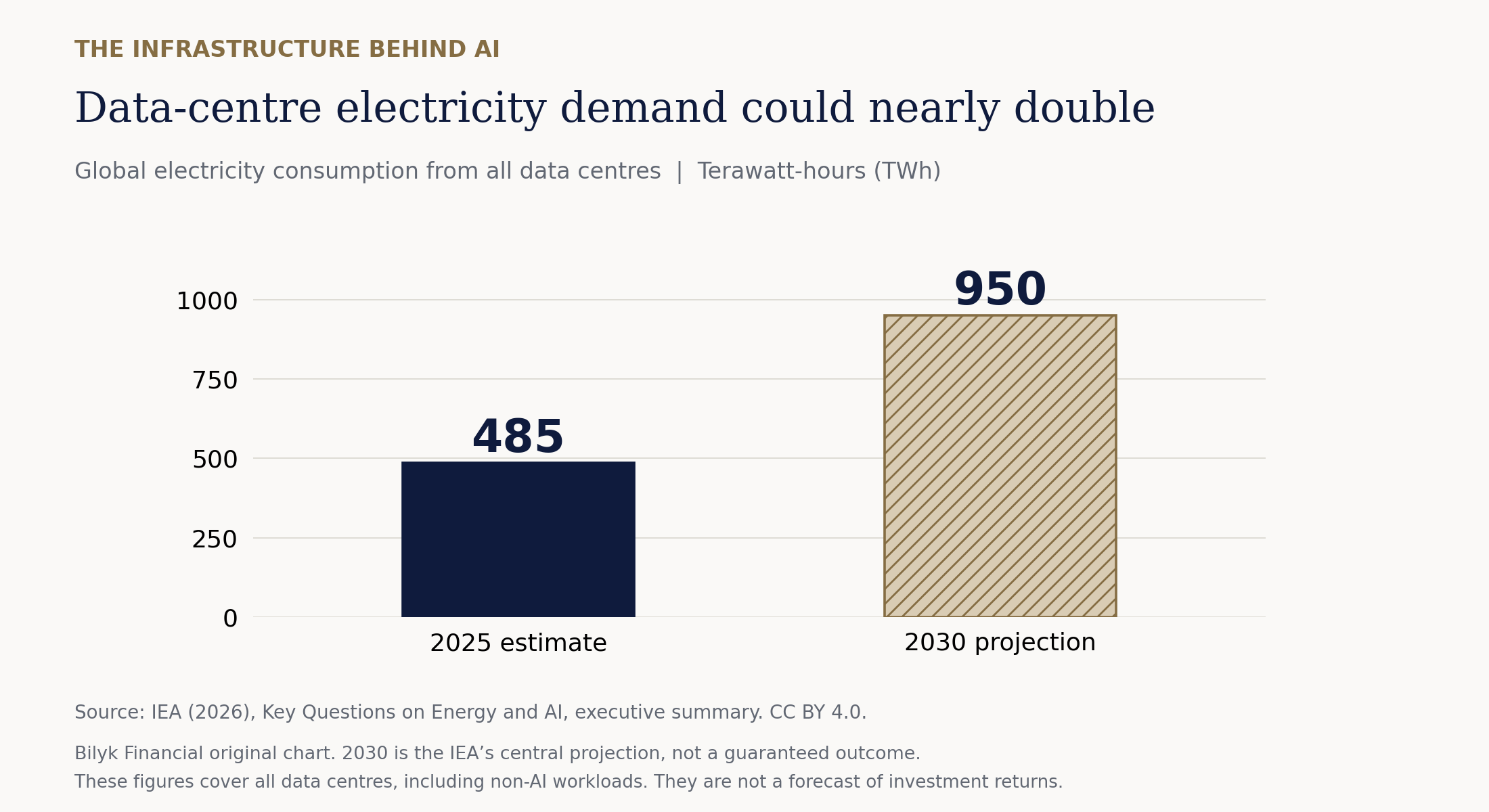
The International Energy Agency’s April 2026 update projects global data-centre electricity consumption rising from an estimated 485 terawatt-hours in 2025 to 950 in 2030. That covers all data centres, including non-AI workloads. It reinforces the scale of the power challenge, while remaining a forecast that can change. [5]
View chart at full size
Celestica provides a clear Canadian example. In its October 2026 results, management linked its growth outlook to demand from major cloud providers and AI customers. That is a reason to study the opportunity, and also a reason to examine what would happen if those customers delayed investment. [6]
The connection varies widely across businesses. The IEA finds stronger links between AI and the valuations of selected equipment and nuclear companies, rather than a broad valuation uplift across the entire energy sector. An electricity-demand forecast alone tells us little about how much a particular company will earn. [5]
For us, the practical questions are about customers and contracts. How much revenue already exists? How much expected growth depends on projects still being planned? Who bears the cost if a project is delayed? These details help distinguish a durable business from an attractive story.
Building resilience company by company
We support Dylan’s view that the individual holdings deserve more attention than a country label. A Canadian business with dependable cash flow and limited exposure to new AI projects may provide useful balance. Another Canadian business may be highly dependent on those projects. Both can sit in the same index.
Nor does lower technology exposure remove the risk of a broad market decline. In its 2026 Financial Stability Report, the Bank of Canada warned that disappointment in AI-related earnings could trigger a repricing of stocks and credit as more infrastructure is financed by debt. The report also describes how liquidity pressures and forced selling can spread market stress. Canadian equities can fall in that environment too. [8]
For Canadian families, the starting portfolio matters. Adding domestic stocks to a portfolio dominated by U.S. technology may improve balance. Adding more to an already concentrated Canadian portfolio can increase familiar risks. Vanguard’s research on home bias is a useful reminder to keep global diversification in view. [9]
Our conviction is that Canada deserves consideration for the businesses it offers and the role each can play. We can remain constructive on the long-term need for energy and infrastructure while being selective about price, debt and dependence on future AI spending. That is how Dylan’s distinction becomes useful in a real portfolio: understand what would have to change for each investment to disappoint, and avoid having too many holdings depend on the same outcome.
Related reading: Did we hit rock bottom?
Sources
- Wealth Professional — Is Canada a useful hedge against the AI trade?. David Kitai, November 13, 2026. Dylan Bredo’s distinction between technology valuations and AI capital spending.
- Bilyk Financial — Midterms, interest rates and the energy behind AI. November 5, 2026. Previous Bilyk Financial perspective. Date follows the page’s displayed byline.
- MSCI — MSCI Canada Index factsheet. October 30, 2026. Sector weights and forward price/earnings ratio.
- MSCI — MSCI USA Index profile. October 30, 2026. Forward price/earnings ratio.
- International Energy Agency — Key Questions on Energy and AI — Executive summary. April 16, 2026. Electricity demand estimates and projections; links between AI and energy-company valuations. CC BY 4.0.
- Celestica — Third-quarter 2026 financial results. October 26, 2026. Company release filed with the U.S. Securities and Exchange Commission, Exhibit 99.1. Management commentary on hyperscaler and AI infrastructure demand.
- Reuters — Canada’s main stock index captures investor attention as AI disruption hedge. Fergal Smith, March 12, 2026. Physical assets and potential productivity gains from AI adoption.
- Bank of Canada — Financial Stability Report 2026 — Overall assessment. May 28, 2026. AI-related earnings risks, debt financing and transmission of market stress.
- Vanguard Investments Canada — Oh Canada! Canadian investors still have high levels of home bias in their portfolios, but are increasing global diversification. June 25, 2024. Vanguard’s public release about its home-bias research, distributed by CNW. Canadian sector concentration and global diversification.