

Insights/Perspective
U.S. and Canadian equities
Did we hit rock bottom?
Nvidia’s sharp rebound shows how quickly sentiment can change. A lasting recovery will need support from earnings, cash flow and customer demand.
By Bilyk Financial ·
Did Friday mark the low? We think it may have marked a low for some AI stocks. Monday’s reversal is encouraging, but a strong morning cannot tell us whether the market has finished falling.
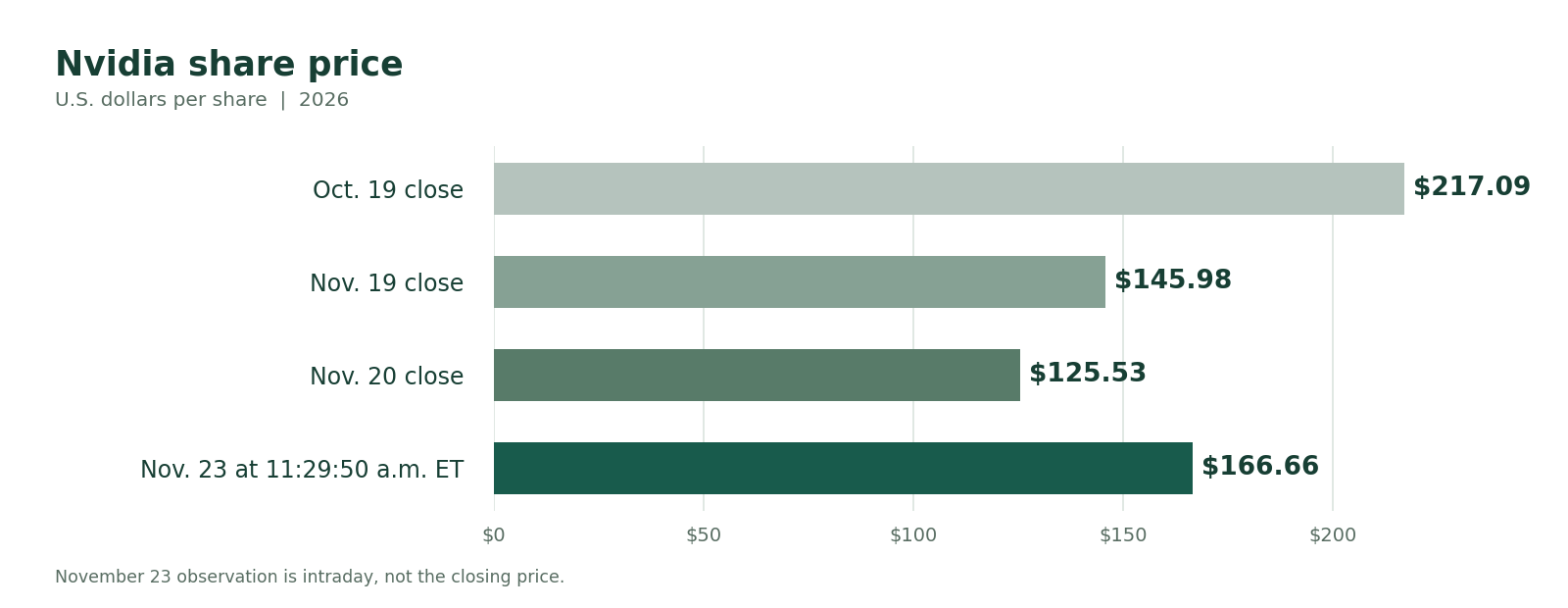
Last week, we asked where the bottom might be for AI stocks. Nvidia closed at US$125.53 on Friday, November 20. At 11:29:50 a.m. Eastern on Monday, November 23, ChartExchange showed US$166.66, a gain of about 32.8%. Between those observations, Nvidia announced that Jensen Huang had been reinstated as president and chief executive officer. Investors were reassessing the company’s future with the same reported quarterly earnings in front of them. Price snapshot · Nvidia announcement
The rebound extended beyond Nvidia. Yahoo Finance’s 10:30 a.m. Eastern update put the S&P 500 up about 5.3% and the Nasdaq Composite up 7.3%. In Canada, the S&P/TSX Composite was up 2.97% at 9:31 a.m., as miners and technology shares rose. Those are substantial moves after a week in which the S&P 500 lost 8.6%. Each Monday figure is an intraday observation, rather than a closing result. U.S. market update · Canadian market open · Friday’s market close
How much ground did Nvidia recover?
View chart at full size
At that Monday snapshot, Nvidia had recovered US$41.13 per share from Friday’s close. It remained about 23.2% below its October 19 close of US$217.09. An investor who bought a month earlier and one who bought on Friday could look at the same rally and have very different reactions.
The price investors were willing to pay for reported earnings changed just as quickly. Using US$9.31 in trailing diluted GAAP earnings per share, Nvidia traded at about 13.5 times earnings on Friday and 17.9 times at Monday’s quoted price. The earnings denominator stayed the same; the share price did not. These are backward-looking multiples, and GAAP earnings include investment gains. They do not tell us what future profits will be. Q4 fiscal 2026 results · Q1 fiscal 2027 results · Q3 fiscal 2027 results
That is why a rebound changes the opportunity as well as the mood. If a business still looks attractive after a sell-off, the price paid for it matters. A higher price deserves a fresh assessment, even when our long-term view of the business has not changed.
What was behind the falling share prices?
There was real business strength during the sell-off. FactSet’s November 20 report showed that, with 93% of S&P 500 companies having reported third-quarter results, 84% had beaten earnings-per-share estimates. Nvidia reported quarterly revenue of US$115.8 billion, up 103% from a year earlier, and US$48.3 billion in operating cash flow. FactSet earnings scorecard · Nvidia quarterly results
Those results support our constructive view of AI demand. They also leave an important question open: will the companies buying the infrastructure earn enough from it to keep investing? A chip sale that becomes revenue for Nvidia is a cost someone else must earn back.
Huang’s return answers the immediate question of who will lead Nvidia. It does not resolve every business risk. Management’s next-quarter gross-margin outlook is 71%–72%, compared with 74.8% in the quarter just reported. On November 20, Reuters also reported, citing people briefed on the matter, that the U.S. Securities and Exchange Commission was examining potential accounting issues. The SEC declined to comment. An inquiry is not a finding of wrongdoing, and its outcome remains uncertain. Nvidia outlook · Reuters reporting
What would give us confidence in a lasting recovery?
We believe AI will become a routine business expense, much as cloud computing has. Microsoft offered one encouraging sign on its October 28 earnings call: the number of Copilot customers actively using credits under usage-based billing grew more than 75% over the quarter. That is a customer-usage measure, not a claim that Copilot revenue grew by the same amount. We want to see customers keep using these services and generate enough value to justify further investment. Microsoft earnings call
We are also watching how much of that demand becomes cash. AMD’s third-quarter data centre revenue grew 97% year over year, while free cash flow fell to US$554 million from US$1.53 billion. Capital expenditures rose over the same period. Sales growth and cash generation can move differently, which is why we want to examine both. AMD quarterly results
Our view is that Friday’s sell-off created opportunities in companies already generating substantial cash from AI. Monday made those opportunities more expensive. We would gain confidence from repeat customer demand, orders that turn into cash, and a recovery that holds beyond the largest technology names.
Those developments would tell us more about a lasting bottom than another big morning for Nvidia alone. We remain constructive about AI’s long-term role while recognising that further volatility and lower prices are still possible.
Related reading: Where Canada can help when the AI trade cools
Market observations are dated November 23, 2026, at the individual times stated. Nvidia’s valuation comparison uses the sum of reported diluted GAAP earnings per share for Q4 fiscal 2026 and Q1–Q3 fiscal 2027: US$1.76 + US$2.39 + US$2.46 + US$2.70 = US$9.31. Percentages and valuation multiples are rounded.